



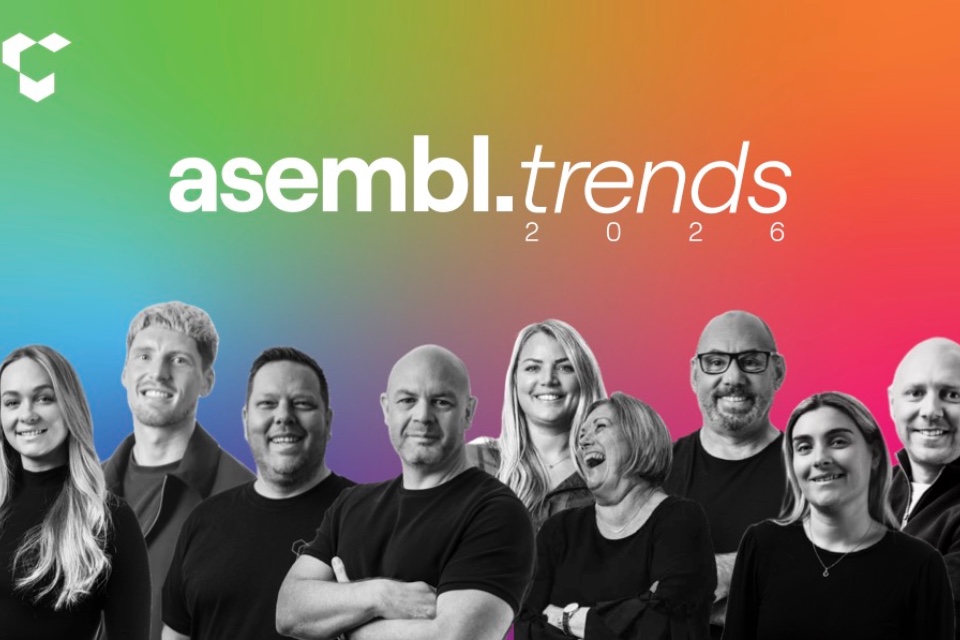
Specialist agency asembl has released its 2026 Trends Report, identifying four fundamental principles that will define the success of live experiences in 2026 and beyond.
The report, developed through analysis of industry data and recently emerged consumer behaviours, challenges brands to rethink traditional approaches to audience engagement, accessibility, technology and communication.
The report presents actionable insights for event planners, backed by compelling data. From the evolution of brand communities to the business imperative of neurodivergent marketing, the findings reveal both opportunities and obligations to ensure businesses remain competitive in 2026.
Asembl CEO Gavin Farley said: “This isn’t another generic trends report, it’s what’s genuinely working for our clients right now. When 85% of neurodivergent people are avoiding events and only 33% of advertising isn’t ‘overly serious’, it’s time to rethink what we’re doing, why and for who. These aren’t optional nice-to-haves anymore – they’re the community strategies, accessibility changes and engagement approaches that are fundamental to staying competitive. The brands, venues and organisers that get and utilise this will own 2026.”
Connected Communities: The End of Broadcasting
The report identifies a seismic shift in how brands connect with audiences, with 94% of organisations reporting that creator content drives more ROI than traditional digital advertising. As the workforce becomes increasingly digitally native – with Millennials and Gen Z projected to comprise 74% of workers by 2030 – brands must evolve from broadcasting messages to facilitating community conversations.
The brands that will thrive in 2026 are those that stop broadcasting and start facilitating, the report states. Audiences do not want to be talked at; they want to be part of the conversation.
Neurodivergent Marketing: From Differentiator to Expectation
With an estimated 1 in 7 people in the UK being neurodivergent, the report highlights inclusive design as a fundamental accessibility requirement rather than an optional enhancement. Research reveals 85% of neurodivergent individuals have avoided events for fear of being overwhelmed, while 88% feel event organisers do not understand their needs.
The report notes that following the European Accessibility Act coming into effect in June 2025, neurodivergent-friendly design is shifting from competitive differentiator to baseline expectation. Major hospitality brands including multiple Marriott properties have already achieved Certified Autism Centre status, setting new industry standards.
AI Personalisation: The Power of Invisible Infrastructure
Drawing on lessons from high-profile missteps, including Spotify Wrapped 2024, which saw positive sentiment drop from 50.5% to 41.5% due to over-reliance on AI, the report advocates for “quiet AI” that enhances human experiences rather than replacing them.
The winners will be companies that use AI as a behind-the-scenes enabler rather than a front-and-centre feature, the report advises. Audiences want to feel seen and understood by the people behind the brand, not by its algorithm.
Positively Playful: Challenging B2B Conventions
The report challenges the assumption that professional communication must be serious, noting that 91% of people prefer brands to be funny, yet only 33% of current advertising could be considered “not overly serious.” With Gen Z set to make up 70% of the global workforce by 2030, brands that embrace authentic personality and strategic playfulness will gain significant competitive advantage.
Being positively playful means embracing humanity without abandoning professionalism, according to the report. It means acknowledging that even in serious industries, there is room for moments of delight, surprise, and yes, even laughter.
Key Findings Include:
· 94% of organisations report creator content drives more ROI than traditional digital advertising
· 85% of neurodivergent individuals have avoided events due to sensory concerns
· 1 in 3 people would choose travel destinations based on absence of language barriers
· 72% would choose a brand that uses humour over the competition
· Gamification boosts engagement by as much as 150% compared to traditional recognition methods
Asembl’s 2026 Trends Report positions these four trends – Connected Communities, Neurodivergent Marketing, AI Personalisation and Positively Playful – as interconnected principles for creating modern, human-centric experiences that treat audiences as individuals rather than metrics.